Introduction
If you’re a permanent makeup removal artist or clinic owner, you’re probably researching microblading removal options. You have likely come across saline removal microblading. Marketers promote it widely, training is easy to find, and it seems straightforward.
But saline microblading removal has a problem it can’t solve. Its designers never built it for the complexity of modern PMU pigments.
Magnetic Tattoo Removal was built for that problem. Mrs. Linda Paradis invented, patented, and perfected it. She understood the problem better than anyone else.
This article explains exactly how microblading removal works. It also shows why your choice of method matters enormously. Finally, it explains why professionals in 50+ countries have switched to Magnetic Tattoo Removal as their go-to removal technique.
What Is Microblading and Why Is Removal So Difficult?
Microblading deposits pigment into the upper dermis with a manual blade. Unlike surface-level pigment, microblading ink sits deep enough to be permanent. However, it sits shallow enough to be unpredictable as it ages.
Over time, microblading pigment can:
- Turn grey, blue, or orange as the iron oxides oxidise
- Migrate unevenly across the brow line
- Build up in layers after multiple touch-ups
- Become resistant to fading from sun or skin renewal alone
This is why simply “letting it fade” rarely works. The removal method must also be precise and skin-safe. In addition, it must work on all pigment types, not just fresh or dark ink.
The Problem with saline tattoo removal for Microblading
Saline microblading removal works through osmosis. A saltwater solution draws pigment fluid upward through the skin, and the fluid then crusts and sheds. It’s a well-known method, and it can produce results in simple cases.
But saline has real limitations that professionals need to understand:
It relies on skin trauma. The practitioner must tattoo saline into the skin aggressively enough to open channels. Multiple passes create more trauma. More trauma means more risk of scarring, especially on the delicate facial skin around brows.
It struggles with colour variation. Saline removal works best on dark pigments. Brows often turn grey, orange, or blue after years of iron oxide oxidation. These brows respond unpredictably to saline.
Healing is unpredictable. Traditional saline methods cause thick, wet scabbing. This scabbing increases the risk of post-inflammatory hyperpigmentation (PIH), particularly on medium to dark skin tones.
It is not patented or FDA-regulated. Saline is a generic solution. It has no exclusive formulation and no worldwide patent. No regulator oversees its use for removal specifically. You can read the
FDA guidance on tattoos and permanent makeup for more background.
How Magnetic Tattoo Removal Works on Microblading
Mrs. Linda Paradis developed Magnetic Tattoo Removal (MTR), a patented, non-invasive technique. It uses a cascade of five simultaneous actions to extract pigment from the skin. It does not cut, burn, or penetrate the dermis.
The 5-Action Cascade:
1. Physical & Mechanical Action Patented Non-Invasive Magnetic Needles (TR88®) move 90 degrees back and forth across the skin surface. They gently exfoliate the stratum corneum, the outermost layer of dead skin cells. They never break the skin barrier.
2. Thermal Action The needle movement raises the temperature of water molecules in the skin’s surface layer. This controlled micro-heat causes invisible evaporation. The evaporation creates a natural vacuum effect that draws the E-Dermis solution deep into the dermis.
3. Ultrasonic Action The magnetic needles produce high-frequency vibration. This vibration disrupts the bonds that hold tattoo ink particles in place. As a result, the particles become easier to extract.
4. Magnetic Action The needles carry a 300-Gauss magnetic charge. This powerful field interacts with the iron-based components of tattoo pigment, including iron oxides in PMU pigments. It pulls them toward the skin surface.
5. Chemical Action The E-Dermis Ink Extractor Solution (100% non-toxic, FDA-regulated) completes the process. It starts a chemical reaction at the molecular level. Pigment particles break down and migrate upward through the skin’s natural regeneration cycle.
The result: the technique extracts pigment from the dermis. It does not burn or destroy it with heat. It works gently, without penetrating the skin, and without trauma.
Magnetic vs. Saline: Direct Comparison
| Factor |
Magnetic Tattoo Removal (MTR) |
Saline Removal |
| Skin penetration |
Non-invasive — skin is never broken |
Invasive — tattooed into skin |
| Scarring risk |
Minimal — a patented, non-invasive method designed to protect the skin |
Present, especially on dark skin |
| Effective on all colours |
Yes — including white/titanium |
Partial — struggles with grey, orange, blue |
| Effective on all skin tones |
Yes — Fitzpatrick I–VI |
Limited on Fitzpatrick IV–VI |
| FDA regulated products |
Yes |
No |
| Patented technique |
Yes — dual worldwide patents |
No |
| Emergency removal |
Yes — within 1–5 days of application |
Limited |
| Hair follicle safety |
Confirmed — no hair loss |
Varies by case |
| Post-treatment skin quality |
Improved — stimulates skin regeneration |
Variable |
Why Skin Tone Matters — and Where MTR Wins
Saline removal performs poorly on medium and dark skin tones (Fitzpatrick IV–VI). That is one of its most significant limitations. Tattooing saline into the skin causes trauma. That trauma can trigger post-inflammatory hyperpigmentation, which creates dark patches that are often worse than the original pigment.
Magnetic Tattoo Removal does not cause this reaction. The technique is non-invasive, and the E-Dermis solution is 100% non-toxic and non-acidic. Therefore, the skin’s melanin production does not go into overdrive. Practitioners safely use MTR on all six Fitzpatrick skin phenotypes — fair, medium, dark, and Asian skin alike.
For clinics serving diverse clientele, this is not a minor advantage. It decides whether you can serve your full client base. Otherwise, you turn away the clients who need help most.
What Professionals Say
“I’ve been using the technique for 3 years now, and my customers are delighted with it, with zero consequences.” — Victoria E., PMU Artist, Paris, France
“Magnetic Tattoo Removal literally removed the ink out of my skin and my tattoos are almost gone now. I highly recommend it to everyone.” — Isabel S., Client
“The depth of information provided, the integrity of the process, and the results compared to traditional laser removal truly blew me away.” — Jessica S., PMU Artist, New York
Can MTR Handle Emergency Microblading Removal?
Yes — and this is one of the most powerful advantages of the technique.
Emergency removal means removing PMU pigment within 1 to 5 days of the original application. At that point, the ink has not yet settled fully into the dermis. This matters for clients who immediately regret a microblading procedure. Typical regrets include shape issues, colour mismatches, and technician error.
MTR is specifically designed to handle emergency cases. The technique works at the surface level, and the E-Dermis solution responds aggressively to fresh pigment. Consequently, results after emergency treatment are often dramatic. Clients often see significant lightening in a single session.
After day 5, the procedure continues to work effectively. However, it no longer counts as emergency removal.
How Many Sessions Does Microblading Removal Take?
Results vary depending on:
- The age of the pigment
- The number of previous applications (layering)
- The pigment brand and colour composition
- The client’s skin type and regeneration rate
In general, clients see visible lightening after the first session. Most complete removal cases require 3–6 sessions. Practitioners space them according to the skin’s natural healing cycle.
Laser can only target certain pigment colours. MTR, in contrast, works on every pigment type. That includes the grey, orange, and yellow tones that resist laser. Microblading clients complain about these tones most often.
Who Can Train in Magnetic Tattoo Removal?
MTR training is designed for professionals, not beginners off the street. Eligible candidates include:
- PMU Artists and Microblading Technicians
- Beauty Therapists and Aesthetic Practitioners
- Dermatologists and Medical Professionals (Nurses, Doctors)
- Tattoo Artists
- Laser Tattoo Removal Technicians seeking a non-laser alternative
Online Training covers 7 days of theoretical video lessons and a comprehensive quiz. You earn certification when you submit client case work.
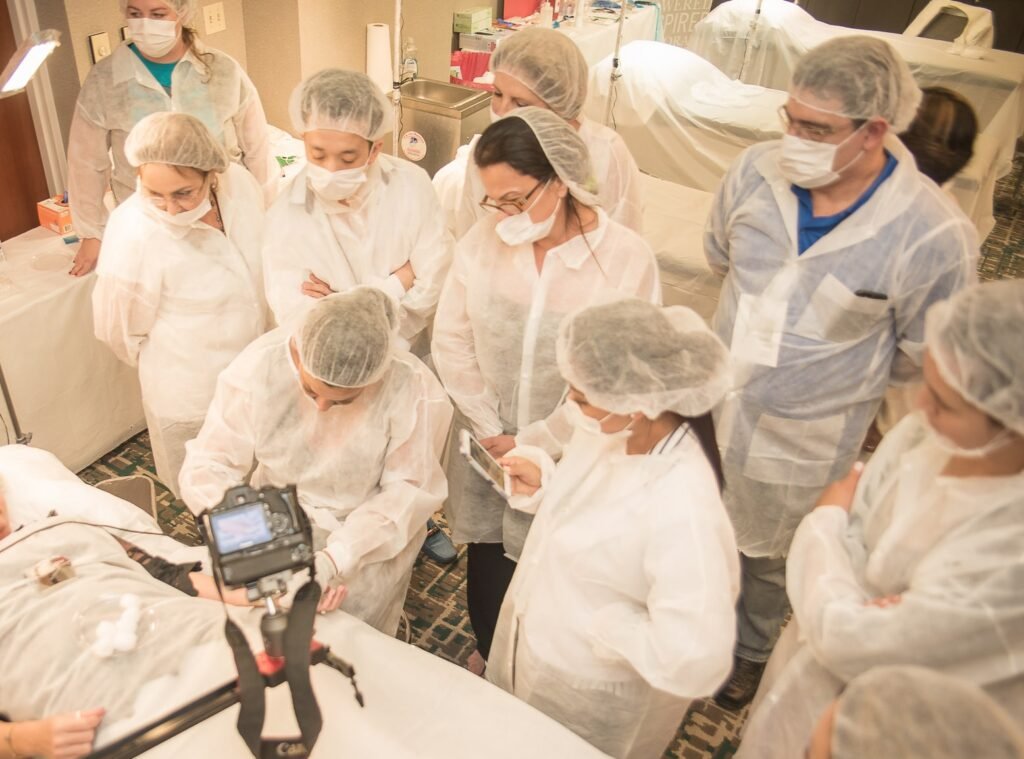
Physical Masterclasses offer hands-on training on live models. Mrs. Linda Paradis, the inventor of the technique, leads them directly.
The Business Case for Adding MTR to Your Clinic
Microblading removal is one of the fastest-growing service requests in the PMU industry. Clients want corrections. They want results from previous work removed. And increasingly, they want it done without laser.
Adding Magnetic Tattoo Removal to your service menu means:
- A new high-ticket revenue stream — MTR treatments typically start at $300–$500 per session
- A recurring client relationship — multi-session removal plans = predictable monthly income
- A competitive edge — very few clinics offer non-laser, non-invasive, patented removal
- A premium brand position — certification by the technique’s inventor sets you apart from any saline-trained competitor
Your first 3 client sessions cover the Course 1 investment of $1,500. From session 4 onward, your consumable cost per treatment is under $40.
Conclusion
Microblading removal doesn’t have to be harsh, unpredictable, or limited by skin tone. With Magnetic Tattoo Removal, the process is non-invasive and scientifically precise. It also works on every pigment type and every skin colour.
Saline removal has its place. However, its designers never built it for the demands of modern PMU correction. MTR was built for them.
Do you want the most advanced, patented removal technique in the world for your practice? Or are you a client who wants to understand your most suitable options? Either way, Magnetic Tattoo Removal by Linda Paradis is the gold standard.
Frequently Asked Questions
Can microblading be fully removed with Magnetic Tattoo Removal? Yes. Complete removal is achievable in most cases. It typically takes 3–6 sessions, depending on pigment depth and layering.
Is Magnetic Tattoo Removal painful? Most clients describe a mild sensation. It causes far less discomfort than laser or aggressive saline methods. No anaesthesia is required.
Does MTR work on all microblading pigment colours? Yes. It works on grey, blue, orange, yellow, and white (titanium-based) pigments. Other methods find these pigments notoriously difficult to remove.
Can I retattoo the area after Magnetic Tattoo Removal? Yes, once the skin has fully healed. The technique actually improves skin quality. This creates better conditions for future PMU work.
How is MTR different from saline removal? MTR is non-invasive, so it never breaks or penetrates the skin. Saline, in contrast, must be tattooed into the skin. Magnetic Tattoo Removal® is gentle on the skin, and it works on all skin tones and pigment colours.
Where can I train in Magnetic Tattoo Removal? Linda Paradis Group offers online and in-person training. Mrs. Linda Paradis, the inventor and patent holder of the technique, leads the courses. Clients often ask first
how long microblading lasts before they consider removal. Practice with an instructor in our
live online hands-on course.