

The short answer
You loved your brows when they were first done. A few years later, you look in the mirror and they’ve turned orange. Or salmon. Or a strange yellowish shade that no brow pencil quite covers. If that sounds familiar, you’re far from alone.
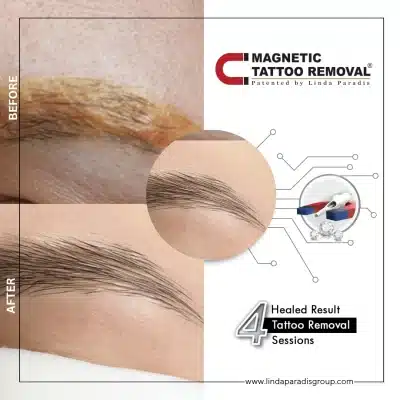
Here’s the good news: yes, yellow and orange eyebrow pigments can be addressed with Magnetic Tattoo Removal®. The technique doesn’t depend on the colour of the pigment to work, and that’s exactly where it differs from laser, which often struggles with warm tones.
That said, colour isn’t the whole story. How deep the pigment sits, how dense it is, how many times your brows were retouched and how your skin heals all shape the result. That’s why every case starts with a proper assessment by a certified technician.
Why do eyebrows turn yellow, orange or salmon?
Most brow pigments aren’t a single colour. A soft brown is usually a blend: darker, cooler tones layered over a warmer base, often made with iron oxides.
The catch is that these components don’t fade at the same speed. The darker tones tend to break down first, and what’s left behind is the warm base underneath. That’s how a natural brown slowly drifts towards orange, peach or yellow, sometimes years after the original appointment.
A few things can speed this up:
- The pigment itself. Blends with a strong warm base are more likely to turn orange as they age.
- Colour correction. Artists often add orange to neutralise brows that have gone grey or blue. Sometimes the correction outlasts the colour it was fixing.
- Sun. UV exposure gradually breaks pigment down.
- Your skincare. Exfoliating acids, retinoids and resurfacing treatments can all affect how pigment fades.
- Layers on layers. Several touch-ups, especially from different artists, can leave a mix of pigments in the same spot.
Why laser often struggles with warm tones
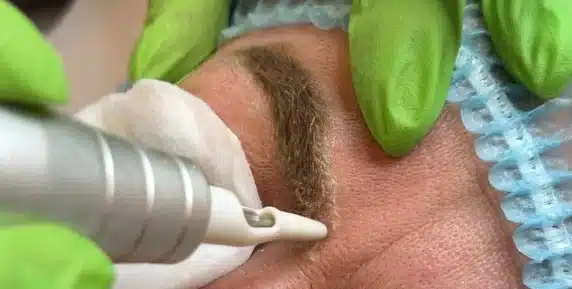
Laser removal works by sending light into the skin. For it to break pigment apart, the pigment has to absorb that particular wavelength. Black soaks up light across a wide range, which is why it usually responds well.
Yellow and orange are a different story. They absorb light mostly in the blue-green part of the spectrum, which most standard lasers don’t target efficiently. So it’s common to hear from clients who’ve had several laser sessions and still have a stubborn orange shadow where their brows used to be.
Brows also bring a few extra concerns with laser:
- Unexpected darkening. Some cosmetic pigments, including certain iron oxide and titanium dioxide formulas, can turn grey or darker when hit with laser energy.
- Close to the eyes. The area needs strict eye protection and a very careful hand.
- Your natural brow hair. Laser energy can affect the hair in the treated area.
It’s no surprise that many people with faded, warm-toned brows go looking for another option.
How Magnetic Tattoo Removal® handles warm pigments
Magnetic Tattoo Removal® is a patented, non-laser technique for extracting pigment, developed by inventor Linda Paradis. Because it doesn’t use light, it doesn’t need the pigment to absorb anything. A yellow or orange brow is looked at in the same way as a brown or black one.
What that means for you:
- Colour isn’t the question. Your technician is far more interested in how the pigment sits in your skin than in what shade it is.
- No laser-related darkening. With no laser energy involved, that unexpected grey or dark shift some pigments show under laser isn’t part of the picture.
- No laser near your eyes. The treatment follows the certified Magnetic Tattoo Removal protocol, without light-based equipment close to the eye area.
- Mixed brows are welcome. If your brows hold several pigments or correction colours, they can be approached as one plan.
Laser Tattoo Removal
Magnetic Tattoo Removal®
How it works
Light energy absorbed by the pigment
Non-laser pigment extraction
Depends on pigment colour
Yes
No
Yellow and orange pigments
Often slow or limited response
Assessed like any other colour
Light-induced darkening
Possible with some cosmetic pigments
Not applicable
Every client is different, and so is every result. Your technician will be honest with you about what’s realistic in your case.
What actually shapes your result
If colour doesn’t decide the outcome, what does? A few things, and a good technician will look at all of them before you start.
- Depth. Pigment sitting close to the surface behaves differently from pigment placed deeper.
- Density. Heavily saturated brows usually need more sessions than light or patchy ones.
- Layers. Brows that have been corrected or retouched several times may hold more than one type of pigment.
- History. Previous laser, saline or other removal attempts affect both your skin and what’s left in it.
- Your skin. Thickness, sensitivity and overall condition all play a part.
- Healing and aftercare. Following your aftercare and giving your skin time between sessions makes a real difference.
What happens at your consultation
The only reliable way to know how your brows will respond is to have them looked at by a certified Magnetic Tattoo Removal technician. Here’s what that usually involves:
- Photos. Clear, well-lit pictures of your brows, ideally in daylight and without makeup.
- Your story. When your brows were done, how often they were touched up, and whether you’ve tried removal before.
- A look at your skin. Your technician checks the skin, the pigment, and anything that might rule treatment out.
- A plan made for you. The approach, the aftercare, and an honest picture of what to expect.
- Your decision. You get all the information you need before anything begins.
Thinking of getting your brows redone afterwards? Mention it. Clearing out the warm residue first gives your next artist a much cleaner base to work with.
Your questions, answered
Why did my eyebrow tattoo turn orange?
Most brow pigments are blends. As the darker tones fade, the warm base underneath starts to show, and your brows drift towards orange, salmon or yellow.
Is yellow pigment harder to remove than black?
With laser, often yes, because yellow doesn’t absorb most standard wavelengths well. Magnetic Tattoo Removal doesn’t rely on light, so the colour itself isn’t what holds things back.
I've already had laser and my brows are still orange. Can Magnetic Tattoo Removal help?
Leftover warm pigment after laser can be assessed for Magnetic Tattoo Removal. Your technician will check your skin and how long it’s been since your last session before suggesting a plan.
Will Magnetic Tattoo Removal make my brows go darker?
No laser energy is used, so the light-related darkening some pigments show under laser isn’t part of the process.
How many sessions will I need?
That depends on how deep and dense the pigment is, how many layers there are, and how your skin heals. You’ll get a personal estimate after your assessment.
Can I get my brows redone afterwards?
Many clients do, once the skin has fully healed. Your technician will tell you when the timing is right.
Where can I find Magnetic Tattoo Removal near me?
Certified technicians work in more than 40 countries. Send us a photo of your brows along with your city and country, and we’ll connect you with someone near you.
The bottom line
Yellow and orange brows are frustrating, for clients and for the artists trying to fix them, mostly because they don’t respond well to laser. Magnetic Tattoo Removal® offers a different route: a patented, non-laser technique where the colour of the pigment isn’t what decides things.
Your own result will still depend on your brows and your skin. The best first step is a conversation with a certified technician.
Ready to talk about your brows? Send us a clear photo with your city and country, and we’ll point you to a certified Magnetic Tattoo Removal technician near you.
Are you a PMU artist or aesthetic professional? Clients with orange, faded brows are walking into salons every day. Take a look at our Magnetic Tattoo Removal® certification programmes and offer them a non-laser solution.
Take the training