

Magnetic Tattoo Removal® vs. saline tattoo removal
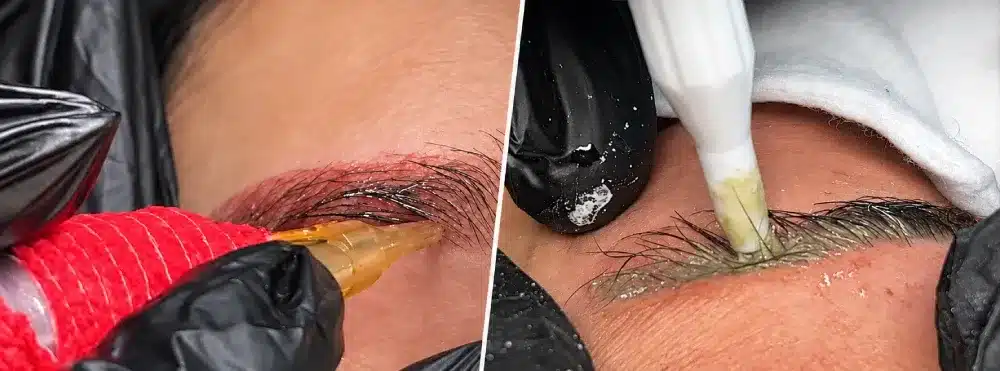
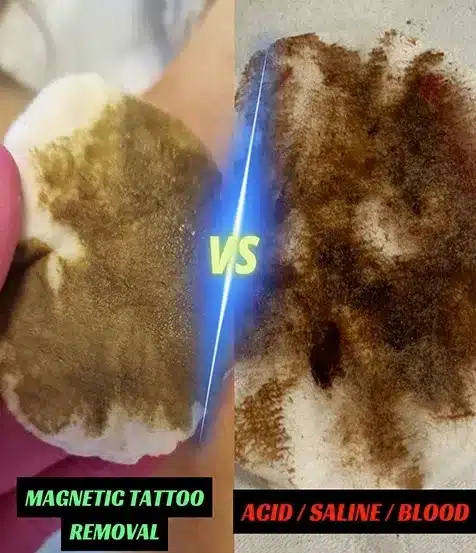
Short answer: NO, Magnetic Tattoo Removal vs saline are not the same technique. Both are non-laser methods that work with the skin’s natural renewal process, which is why people often compare them. In contrast, saline removal relies on a saline (salt-based) solution, with formulations and techniques that vary from one provider to another. By comparison, Magnetic Tattoo Removal® is a patented method with a proprietary, documented formulation and a single standardized protocol taught through certified training.
What the two methods have in common
How Saline Works Compared With Magnetic Tattoo Removal
Specifically, saline removal introduces a concentrated salt-based solution into the pigmented area. As a result, the solution draws pigment toward the surface through osmosis, and the treated area releases the pigment as it heals. Moreover, many commercial saline products exist, and application technique, concentration, and aftercare differ between brands and trainers.
First, Mechanical Trauma (Overworking the Skin)
Unlike lasers, which pass through the surface of the skin seamlessly, saline removal requires a technician to physically break open the epidermis using a tattoo machine or microblading needle. Furthermore, if a technician goes too deep into the dermis or makes too many passes over the same area, they create a severe physical wound. As a result, the body enters an emergency healing response and overproduces collagen, leading to a raised scar. [1, 2, 3, 4, 5]Second, Dehydration and “Osmotic Burns”
Specifically, saline removal relies on osmosis—using a highly concentrated hypertonic salt solution to pull interstitial fluid and pigment particles up to the skin’s surface. However, salt is an extreme dehydrator. If the technician leaves the solution on open skin for too long, or if the concentration is too aggressive, it completely dries out the surrounding healthy cells. Therefore, this severe local dehydration can mimic a chemical burn, resulting in tissue necrosis (cell death) and triggering thick, fibrous tissue repair. [1, 2]Third, Premature Scab Removal
In fact, saline removal forces the body to create a heavy, thick scab that binds with the lifted ink. Moreover, this scab must fall off entirely on its own (usually taking 7 to 10 days). For instance, if a client accidentally picks, scratches, or rubs the scab off early, it tears away the newly forming epithelial skin layer underneath. Consequently, this restarts the inflammatory process and drastically increases the likelihood of a bumpy, hypertrophic scar. [1, 2, 3, 4, 5]Finally, Inadequate Healing Time Between Sessions
In contrast, healthy skin takes roughly 4 weeks to superficially heal, but it takes 8 to 12 weeks for the underlying dermal layers to completely remodel and regain their strength. For example, if a technician schedules a secondary removal session too soon, they are tattooing into a highly vulnerable, still-remodeling wound. Ultimately, rushing the timeline breaks down the skin barrier repeatedly, very likely causing a permanent textural deformity. [1, 2]Magnetic Tattoo Removal vs saline: pH and Chemical Composition
How Magnetic Tattoo Removal® works
Linda Paradis developed Magnetic Tattoo Removal®, and international patents have protected it since the early 2000s. Specifically, it combines two actions that work together. The first is a proprietary liquid extraction composition from the E-Dermis line, which interacts with the pigment and carries it toward the skin’s surface. Meanwhile, the second is a set of magnetised needles, which is what gives the method its name.
In addition, as described in US Patent No. 11,376,183, the practitioner coats the needles with the composition and moves them back and forth over the treated area. Additionally, this acts superficially on the outermost layer of the skin and helps the composition migrate to where the pigment sits.
Also, because many pigments contain metal compounds, such as the iron oxides widely used in permanent makeup, the magnetised needles add a magnetic attraction to the extraction. In other words, Magnetic Tattoo Removal does not rely on osmosis from a concentrated salt solution, which is the principle behind saline removal.
Finally, every certified practitioner follows the same protocol, uses products with documented composition and cosmetic notification (CPNP), and applies a defined hygiene procedure. As a result, that standardization is what allows the method to be taught, audited, and compared consistently across more than 50 countries.
Side-by-side comparison
| Criterion | Saline removal | Magnetic Tattoo Removal® |
|---|---|---|
| Category | Non-laser pigment removal | Non-laser pigment removal |
| Active solution | Saline-based; formulation varies by brand | Proprietary liquid extraction composition (E-Dermis line) |
| How pigment is lifted | Osmosis: a concentrated salt solution draws pigment toward the surface | The composition's interaction with the pigment, combined with magnetic attraction from magnetised needles |
| Intellectual property | Widely practiced technique, not owned by a single inventor | Patented method and device, protected in 12+ jurisdictions since the early 2000s, including US Patent No. 11,376,183 |
| Product documentation | Depends on the product used | Documented ingredients list and CPNP cosmetic notification |
| Protocol | Varies between trainers and studios | One standardized protocol, with a defined hygiene procedure |
| Training | Offered by many independent providers | Certification delivered by Linda Paradis Group, with a structured training program |
| Typical applications | Mainly permanent makeup and microblading | Permanent makeup, microblading, and body tattoos |
| Practitioner network | Independent practitioners | 2,000+ certified practitioners in 50+ countries |
E-Dermis Magnetic Ink Extractor®: Product Label and Ingredients
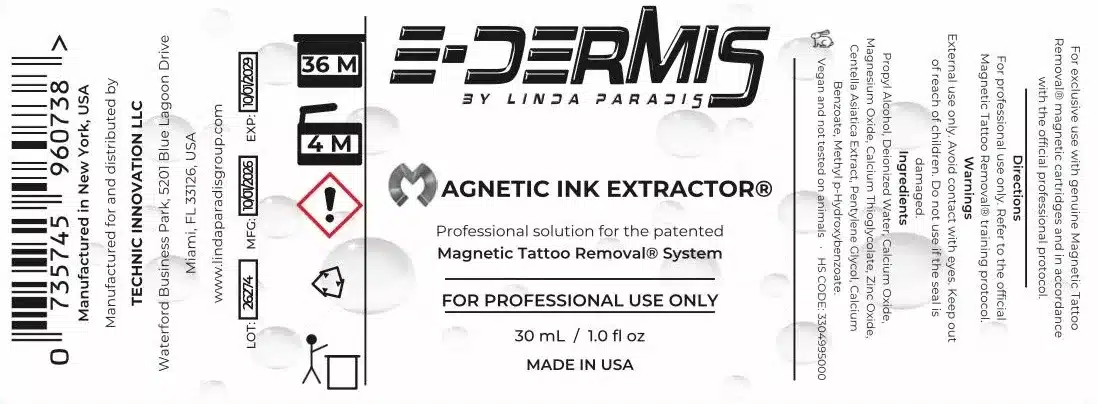
Ingredients: Propyl Alcohol, Deionized Water, Calcium Oxide, Magnesium Oxide, Calcium Thioglycolate, Zinc Oxide, Centella Asiatica Extract, Pentylene Glycol, Calcium Benzoate, Methyl p-Hydroxybenzoate.
Why Magnetic Tattoo Removal vs saline causes confusion
Choosing Between Magnetic Tattoo Removal And Saline
Ultimately, the right approach depends on the tattoo, the skin, and the client’s expectations. Therefore, we recommend a consultation with a certified practitioner who can assess the area, explain the expected number of sessions for that case, and describe aftercare before any treatment begins. Finally, a reputable practitioner of either method should be willing to show credentials and explain their protocol.
Frequently asked questions
No. Both are non-laser methods that rely on the skin’s natural renewal process, but Magnetic Tattoo Removal® is a patented method with a proprietary, documented formulation and one standardized protocol taught through certified training. Saline removal uses saline-based solutions whose formulation and technique vary by provider.
The official Magnetic Tattoo Removal® protocol uses E-Dermis Ink Extractor and original Magnetic Needles.
If a practitioner uses elements of our technique with a saline-based remover, this changes the procedure and does not follow our official protocol.
We do not recommend this substitution and cannot confirm its safety or results. These modified procedures should not be presented as official Magnetic Tattoo Removal® treatments.
The name comes from the magnetised needles used in the method. US Patent No. 11,376,183 covers needles with a magnetic induction field above 300 Gauss, used to extract pigments that contain metal compounds through magnetic attraction. This magnetic action works alongside a proprietary liquid extraction composition.
No. The Magnetic Tattoo Removal extraction composition is not a saline solution, and its action does not rely on osmosis. It is a proprietary liquid formulation with a documented ingredients list and CPNP cosmetic notification, applied with magnetised needles.
No. Magnetic Tattoo Removal® does not use laser or any light-based device.
Yes. Certified training covers both permanent makeup and microblading removal and body tattoo removal. Suitability and the number of sessions are assessed case by case during consultation.