

Who Invented Magnetic Tattoo Removal, and When Did It Begin?
Magnetic Tattoo Removal Origin & Patent History
Magnetic Tattoo Removal® is a patented, non-invasive pigment extraction technique that Linda Paradis, founder of Linda Paradis Group, invented. Therefore, she built it to answer the limits of laser tattoo removal: tissue damage, scarring, and unpredictable pigment reactions. Today, more than 40 countries certify it, and over 2,000 practitioners use it worldwide.
First, this article traces the origin of the technique. It covers the problem Linda Paradis set out to solve, and the regulatory path that took it from one innovator's concept to a certified protocol.
The Problem: Why Laser Tattoo Removal Falls Short
Before Magnetic Tattoo Removal existed, professionals removing tattoos, microblading, and permanent makeup relied primarily on three approaches:
- Laser ablation, using high-energy light beams to break down pigment particles
- Dermabrasion, mechanically removing the top layer of skin
- Saline or chemical-based removal, drawing pigment out through osmotic or acid-based reactions
Each of these methods can produce results, but they share a common limitation. However, their makers did not design them for the precision that permanent makeup and microblading need. As a result, clients often saw textural changes and uneven pigmentation. In some cases, clients had permanent scarring, particularly on delicate areas like the brows, lips, and eyeliner line.
Magnetic Tattoo Removal Origin: How It Began
Overall, Linda Paradis is an internationally known trainer, practitioner, and examiner in the permanent makeup and tattoo removal industry. She began developing the technique after she saw repeated skin damage from laser methods in her own clinical practice and training work.
The concept behind Magnetic Tattoo Removal is simple. Instead, it extracts pigment through a mechanical, non-thermal process. Specially engineered magnetic needles and cartridges replace heat, light, and chemical solutions. Linda designed this approach to work with the skin's natural structure, not against it. It targets the pigment layer without the thermal damage that laser treatment can cause.
Eventually, the technique reached the professional market in the early 2020s. Since then, clinical training and practitioner feedback have refined it since, and it now covers new applications, including microblading removal, lip and eyeliner permanent makeup removal, scalp micropigmentation removal, and body tattoo removal.
Magnetic Tattoo Removal Origin: Patent Protection and Regulatory Status
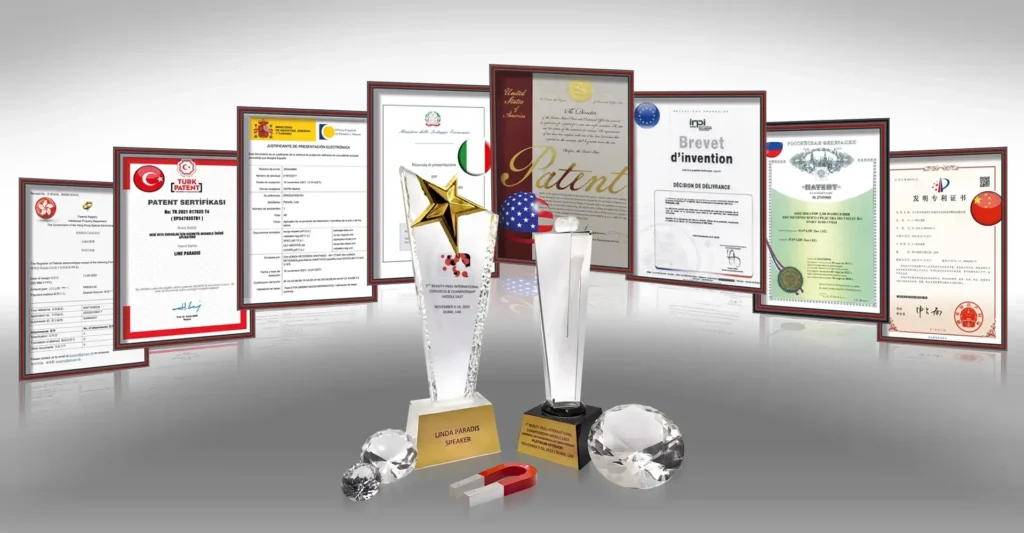
Patents protect Magnetic Tattoo Removal in 12+ jurisdictions worldwide. Overall, this shows it is an original, proprietary technique, not a variation of an existing method. The protocol uses FDA-regulated equipment and consumables, and professionals can use the technique in more than 40 countries.
This regulatory and legal foundation sets Magnetic Tattoo Removal apart from generic "non-laser" alternatives. In addition, the technique, its equipment configuration, and its training protocol all come from a single, documented source of invention.
Magnetic Tattoo Removal Origin: From Innovation to Global Training Network
This clinical solution has grown into a structured international training and certification system. Today, Linda Paradis Group certifies practitioners through:
- The Foundation Programme, for practitioners new to the technique
- The Online Zoom Master Class, a hands-on certification course
- The Perfection Class, for advanced protocol refinement
Certified practitioners learn the mechanical application of the technique. They also learn patient assessment, because the right protocol depends on factors such as tattoo age, ink density, ink composition, pigment depth, and the individual's skin characteristics.
Why the Magnetic Tattoo Removal Origin Matters
In an industry that sometimes uses technique names loosely or without attribution, understanding the origin of Magnetic Tattoo Removal matters for two reasons:
- For practitioners, it identifies the original, patented source of training and certification. In contrast, unlicensed adaptations may not reflect the original protocol's safety standards.
- For clients, it provides a basis for informed decision-making when comparing tattoo and pigment removal options.
In fact, Linda Paradis did not adapt Magnetic Tattoo Removal from an existing laser or chemical method. She built it from the ground up as a non-invasive alternative, after she identified a gap in the industry and engineered a solution to close it.
FAQs
Is the E-Dermis Ink Extractor Solution safe to use?
The E-Dermis Ink Extractor Solution has been used globally for over twenty years, with its formulation continuously refined by a laboratory based in New York. It is a cosmetic-grade product, manufactured in the USA and formulated specifically for use alongside the patented magnetic needle system.
What's in the extraction solution?
The formulation is built from established cosmetic-industry ingredients, including: • Distilled water — base solvent • Propanol — cosmetic preservative • Magnesium oxide — viscosity control • Centella asiatica extract — antibacterial, anti-inflammatory, anti-aging • Methyl p-Hydroxybenzoate — preservative, antibacterial • Zinc oxide — cosmetic pigment base • Pentylene glycol — stabilizer and texture improver • Calcium thioglycolate — used widely in personal care formulations
Is this the same as saline?
No. Saline reopens the tattoo with a salt solution. Saline has a pH that typically ranges from 4.13 to 6.80. This protocol uses patented non-invasive magnetic needles with the E-Dermis Ink Extractor Solution with a pH of 8.5 to 9.0. People mix them up because both get called “non-laser.” Different machine. Different liquid.
Is the extraction solution FDA-approved?
This is a common question. The FDA regulates food, drugs, and medical devices — cosmetic products like ours are not subject to FDA premarket approval in the same way as drugs or medical devices. Our Ink Extractor Solution is a USA-manufactured cosmetic product, and Magnetic Tattoo Removal® is a professional cosmetic procedure performed using our patented system by trained, certified practitioners.
Learn More
About the Inventor · What is Magnetic Tattoo Removal? · Comparison Guide
This article serves professional and educational purposes. Magnetic Tattoo Removal is a patented, FDA-regulated technique. Individual results vary based on tattoo characteristics and skin type; no specific outcome is promised.